
Problem
The big problem
Since the COVID-19 pandemic, attempts to eradicate bat populations have spiked, driven by unfounded fears about disease transmission.
Bats are America's most rapidly declining and threatened warm-blooded animals. Alarming losses of free-tailed bats have been reported, though their population status is inadequately monitored. Even the Congress Ave. Bridge bats appear to be in decline.
Based in Austin — the "City of Bats" — we set out to raise empathy for the 1.5 million bats living near the Congress Avenue Bridge.
How might we help people empathize with bats and reduce the irrational fear resulting from the COVID-19 pandemic?
Approach
UX roadmap
Because the experience layered content research, a VR application, and a 3D-rendered space, we used an agile, iterative methodology to weave them together across four phases.
Phase 01
Empathize
Secondary research on bats' ecological role, plus surveys to surface attitudes and fears.
Phase 02
Ideate
Explored storytelling avenues in VR and storyboarded the core gameplay loop.
Phase 03
Prototype
Built a mid-fi Unity prototype, then a hi-fi version ready for user testing.
Phase 04
Test
Designed pre/post questionnaires and ran a VR showcase with peers and faculty.
Phase 1
Empathize
Why bats matter
To better understand the problem space, I researched the environmental role of bats and reviewed studies on how virtual environments can be designed to combat fears related to animals.
Fact 01
They reduce pesticide use
Bats save farmers an estimated $1B annually by intercepting migrating pests and reducing egg-laying on crops.
Fact 02
They pollinate & disperse seeds
Bats are responsible for pollinating and dispersing seeds of plants like the blue agave.
Fact 03
They aren't disease-ridden
Bats carry no more disease than other wild animals — but unfounded speculation reinforces the stigma against them.
Examining attitudes
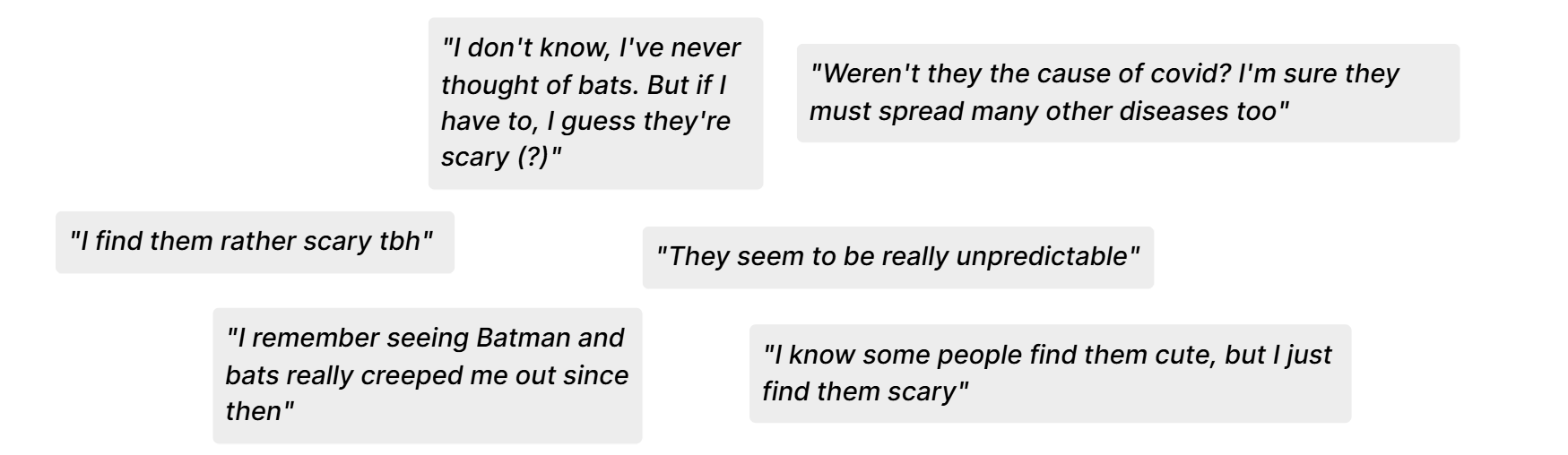
I surveyed classmates to understand how Austinites actually view bats. The pain points were clear: bats are perceived as scary, and it is hard to empathize with something you fear.
Phase 2
Ideate
Three insights from academic research
Takeaway 1
Proteus effect
Embodying a bat avatar (or watching 360° bat documentaries) significantly increases empathy for the species and weakens anthropocentric framing.
Takeaway 2
Bodily ownership
Inhabiting a body radically different from one's own creates strong feelings of immersion, presence and ownership — which in turn shifts emotion and behaviour.
Takeaway 3
Empathy in VR
If a user inhabits an animal's avatar, they begin to think and act like that animal — opening real possibility for cross-species empathy.
Storyboarding the challenge
We settled on a game where the player embodies a bat and captures mosquitoes placed along its flight path — turning a 'scary' creature into an obvious helper.

Choosing the equipment
We used the Meta Quest 2 for its accessibility, untethered tracking, and high refresh rate — enhancing immersion while reducing motion sickness.

Lo-fi sketches & POV decision
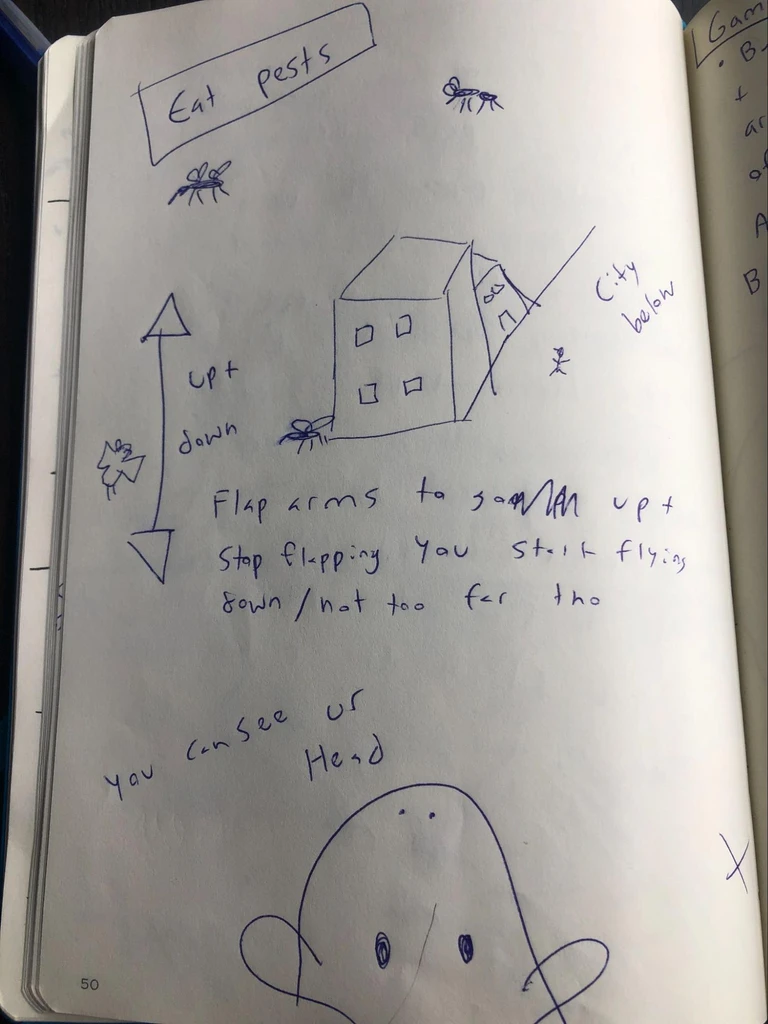
First-person POV maximizes Illusion of Virtual Body Ownership (IVBO), but the user can't see the bat, undercutting empathy. Third-person flips the trade-off. We landed on a hybrid POV: the camera sits slightly above the bat so players see the avatar without losing presence.
Phase 3
Prototype
Mid-fi (Unity)
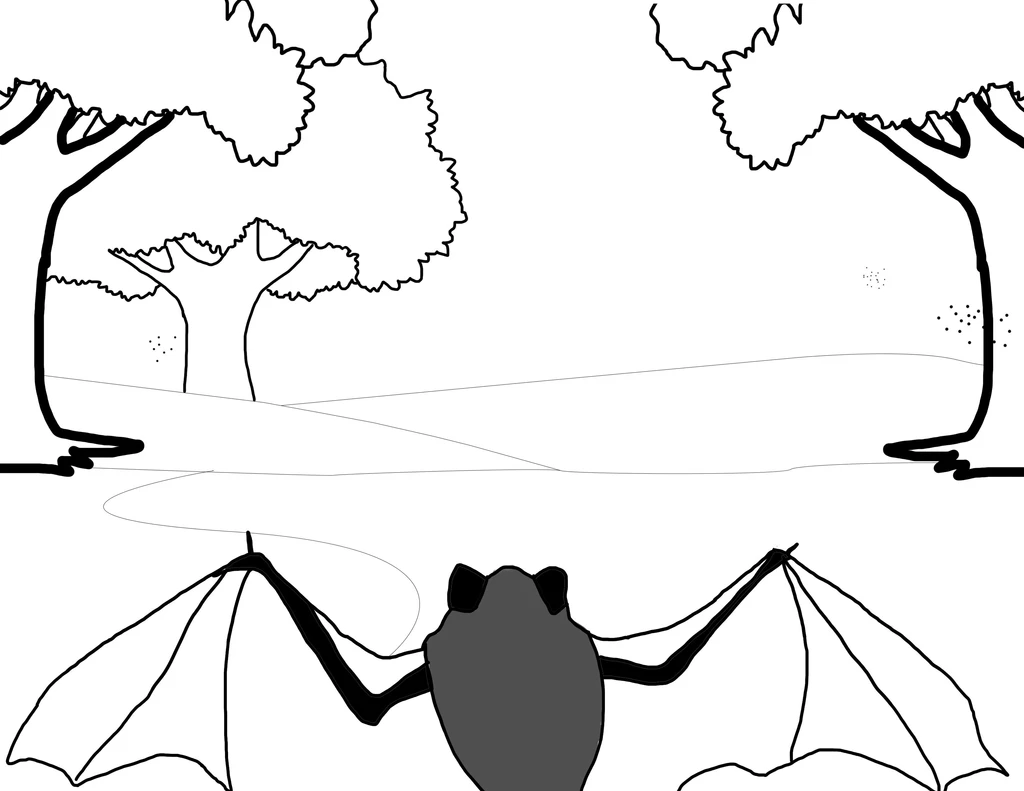
The mid-fi prototype featured a freely-moving bat in an urban forest with mosquito targets triggered by an Oculus controller button. The risk: simulator sickness from the bat's altitude and the unobstructed flight path.
Sketching the hi-fi
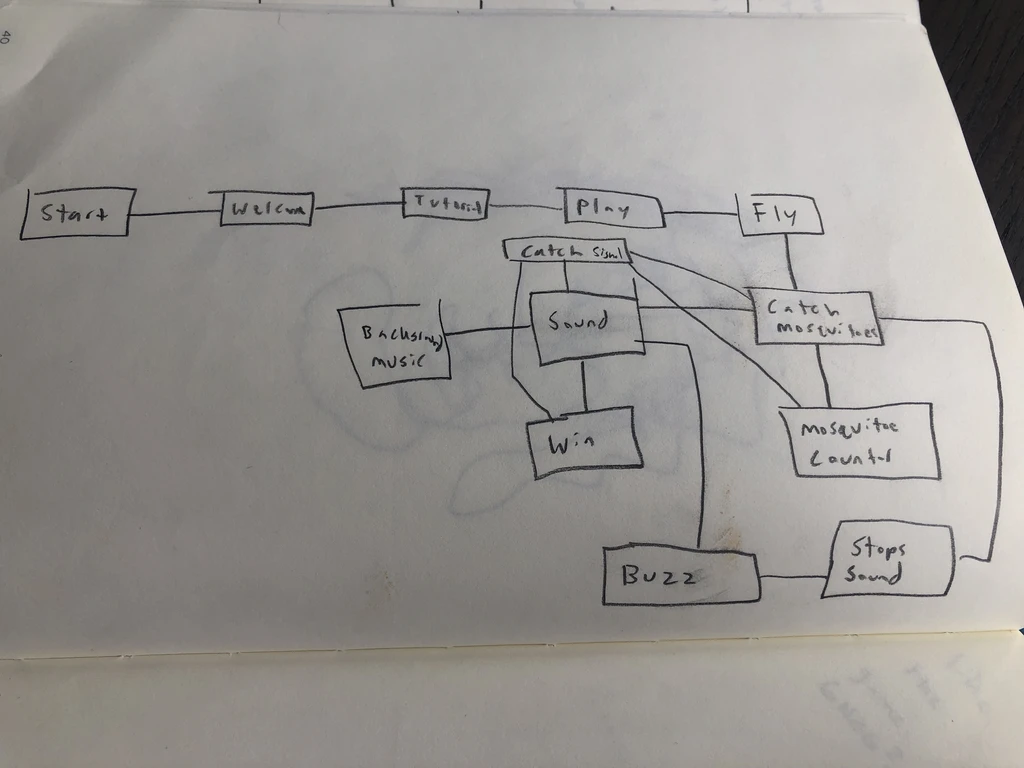
We sketched the game flow on paper to nail down features and characters. Ideas included pleasant background music to set the mood, plus a 'snap' sound and haptic feedback on successful mosquito catches.


Hi-fi prototype
An important point of contention was how the user would embody the agent. Our secondary research suggested that first-person embodiment yields the highest IVBO (Illusion of Virtual Body Ownership), but doesn't deliver the same empathy with the avatar — because the user can't see it. A third-person POV reverses the trade-off: more empathy, less IVBO.
We landed on a hybrid POV: the camera sits slightly above the bat so the user can see Batsy as it moves, without feeling fully detached. We constrained the flight path to reduce simulator sickness and built out the final scene in Unity.
Phase 4
Test
We hosted a VR showcase at UT Austin. 22 participants completed pre- and post-experience Likert questionnaires measuring self-presence, spatial presence, empathy and behavioural engagement.
66%
Self-presence
80%
Spatial presence
77%
Empathy
77%
Behavioural engagement
A participant trying our VR game
What the scores mean
Self-presence · 66%
- 72% felt the avatar represented them
- 77% felt that 'when something happens to my avatar, it was happening to me'
- 59% felt able to control the avatar 'as though it were my own'
Spatial presence · 80%
- 91% felt they were inside the virtual world
- 86% felt 'as if I was visiting another place'
- 91% felt 'like I could reach out and touch the objects in VR'
Empathy · 77%
- 73% felt compassion for Batsy
- 72% imagined themselves in Batsy's situation
- 59% felt protective towards Batsy
Behavioural engagement · 77%
- 73% felt their avatar represented them
- 73% felt the avatar's experiences were happening to them
- 73% felt able to control the avatar as their own
The game shifted attitudes toward bats in 10 of 22 participants (48%): three moved from positive to more positive, three from neutral to positive, and three from negative to positive.
I have been unsure about the utility of VR for dealing with social issues. However, this game has given me a more moderated perspective. I still think that the VR hardware itself can be made more accessible.
I am still a bit scared of bats but I now realize that they're just like any other animal.
Insights
What we'd build next
The user testing surfaced three clear opportunities for the next iteration of the game.
Teach the controls
The game doesn't currently test whether the user has understood the controls.
- Create a help directory accessible from the main menu and during play.
- Add an optional tutorial that verifies the user has understood the controls.
Expand the storyline
The game can be expanded to accommodate richer storylines and actionable advice.
- Add more levels (e.g. the Texas Freeze) for replayability and complexity.
- Add resources on bat conservation efforts to contribute beyond the game.
Improve accessibility
The game isn't fully accessible to people with disabilities or other linguistic backgrounds.
- Allow transition to voice input.
- Offer multiple language options.
- Add audio directions for users who cannot read.
What worked
Takeaway 1
First-person POV builds understanding
Embodying the bat helped people go through its daily experiences and gave them a better understanding of what the animal actually contends with.
Takeaway 2
Easy controls + clear visual language
The game was easy to follow and the controls intuitive. The colour scheme made targets distinguishable, and the storyline was developed enough to incite empathy and interest.
Takeaway 3
Preset path beats VR sickness
Constraining the flight path was the right call — it almost entirely eliminated simulator sickness in our participants while keeping targets reachable.
Takeaway 4
Cute beats realistic for empathy
People empathised more easily with simpler, animated faces than realistic ones. The cute bat avatar and warm world-building did the heavier lifting for empathy.
Reflection
Lessons learned
Takeaway 1
Distilling academic research into UX
I learnt how to translate findings from academic research into UX guidelines, build an MVP from them, and then use that MVP to gather feedback from users — a meaningfully different loop from the traditional UX cycle.
Takeaway 2
Designing around hardware limits
Working with the Oculus gear pushed me to design around refresh rates, rendering budgets, simulator sickness and the strictures of an immersive space — constraints that ended up shaping the research design itself.
Takeaway 3
The value of VR for social issues
It was rewarding to map out where VR's empathic capacity opens new opportunity spaces for artistic and social experiments — and where its current capabilities still fall short.